Who speaks for the people that markets treat as companies, and what Thursday’s Citizens’ Energy Forum will tell us.
One contract covered the salon downstairs and the home upstairs.
She was a hairdresser in Belgium. Her chairs, her dryers and the kitchen above them all ran on the same supply, under the same business contract. She fell behind on her payments. What followed was the risk of a complete disconnection, of the shop and of the home, because the contract recognised only one of them.
By the time her file reached me, at the ombudsman service where I handled complaints from micro and small businesses, the threat had already landed.
Small businesses live like households and are judged like corporations
What I saw in those files, I keep seeing now. The smallest businesses had far more in common with households than with large companies. The same fragile cash flow. The same month-to-month arithmetic. In her case, the same person deciding which bill to pay first, for the salon and for the home.
Yet the rules expected them to behave like corporations: to read their contracts closely, follow the market, and defend their interests with the resources of a firm that has a legal department. The system saw a business. The home upstairs stayed invisible, and so did the protections a household would have had.
The pattern reaches well beyond one salon, and well beyond Belgium. The challenges individuals face keep growing in size, while the political response stays small, slow and scattered.
This month on Energ’Ethic, I spoke with Tom Lowe, who leads the energy networks and systems team at Citizens Advice, a statutory consumer advocate for energy. Listen to the episode here. One of the first files he worked on, back in 2010, concerned energy brokers taking advantage of small businesses. By his account, it took nearly fifteen years before the regulator began to supervise those brokers directly. The problem was visible from the start. The response took a decade and a half.
His organisation holds a legal mandate that turns requests into requirements. It can ask energy companies for data, raise super-complaints to the competition authority, and expect an answer, because the law requires one. As Tom put it, the companies know where they stand: “They have to have a conversation with us. They have to provide us with data.”
The same lesson appears in Poland. Years of meetings and voluntary commitments from suppliers did not reduce complaints about door-to-door sales. A legal ban did: by 2024, those complaints had fallen to 0.3% of all energy complaints.
Every institution sees one slice of the same person
Institutions underestimate the scale because none of them sees it whole. The energy supplier sees an unpaid bill. The water company sees another. The broadband provider sees a line to cut. Social services see the debt once it has become a crisis. Each acts within its own remit and at its own pace. The person carries everything at once.
Europe’s energy regulators supplied the evidence in their own consumer protection report, published on 21 September. Across 21 national regulators, most report no legal definition of what a complaint is. In twelve countries, a company that misses its deadline to answer a complaint owes the complainant nothing. On small businesses, one regulator learns about abusive contract terms only through individual requests. No shared definition. No compensation. No overall picture.
Tom described this plainly: people rarely arrive with a single problem. Financial difficulty with the energy company tends to travel with arrears on broadband and water. The pressures compound, and today they compound faster: the cost of living, a summer of heat and wildfires across Europe, and a steady erosion of trust in the people who make policy.
Institutional time runs on a different clock. In the episode, Tom explains how long even a reform that everyone welcomes takes to arrive.
Meanwhile, trust drains away. Tom cites Citizens Advice research in which only one person in ten believes government does enough to protect ordinary consumers in their dealings with big businesses, and seven in ten think the company holds the stronger position in any dispute.
The same absence surfaced in the previous episode, on inclusive energy services in the Italian market, where the lack of a single voice for consumers was part of the diagnosis.
Standing is the cheapest form of adaptation
On 16 September, in her State of the Union address, the Commission President observed that only around a quarter of catastrophe losses in Europe are covered by private insurance. Far too often, she said, national budgets become “the insurer of last resort.” Her response is a climate insurance alliance, followed by a climate resilience framework announced for October.
I read that sentence as a diagnosis of consumer markets too. When a market fails the people who cannot walk away from it, someone absorbs the loss: an ombudsman, an advice service, a social worker, a family. They are the insurers of last resort for market failure. The question is whether anyone has priced that role, and whether anyone has standing to challenge the costs that land on households before they land.
Adaptation economics has already settled the principle. In June 2025, an analysis of 320 adaptation investments across twelve countries found that every dollar invested returns more than ten dollars in benefits over ten years. Tom gives a figure from his own field: on the advice side, twelve pounds of value for every pound invested, funded by a levy of a few pence on energy bills. Prevention costs less than repair. I have yet to see consumer protection budgeted that way.
Without trust, there is no support: for the transition, for the market reforms of the Citizens Energy Package, and for the European Union that designed them.
The timing sharpens the question. On 25 September, the Energy Commissioner warned energy ministers that Europe is facing “a price crisis linking to a supply crisis,” and asked them to prepare urgently for the heating season, including by reducing gas and electricity demand. For someone with a home above her salon, winter is when a late payment weighs heaviest. When the winter measures are drawn up, the question is who will speak for her.
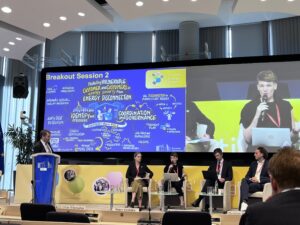
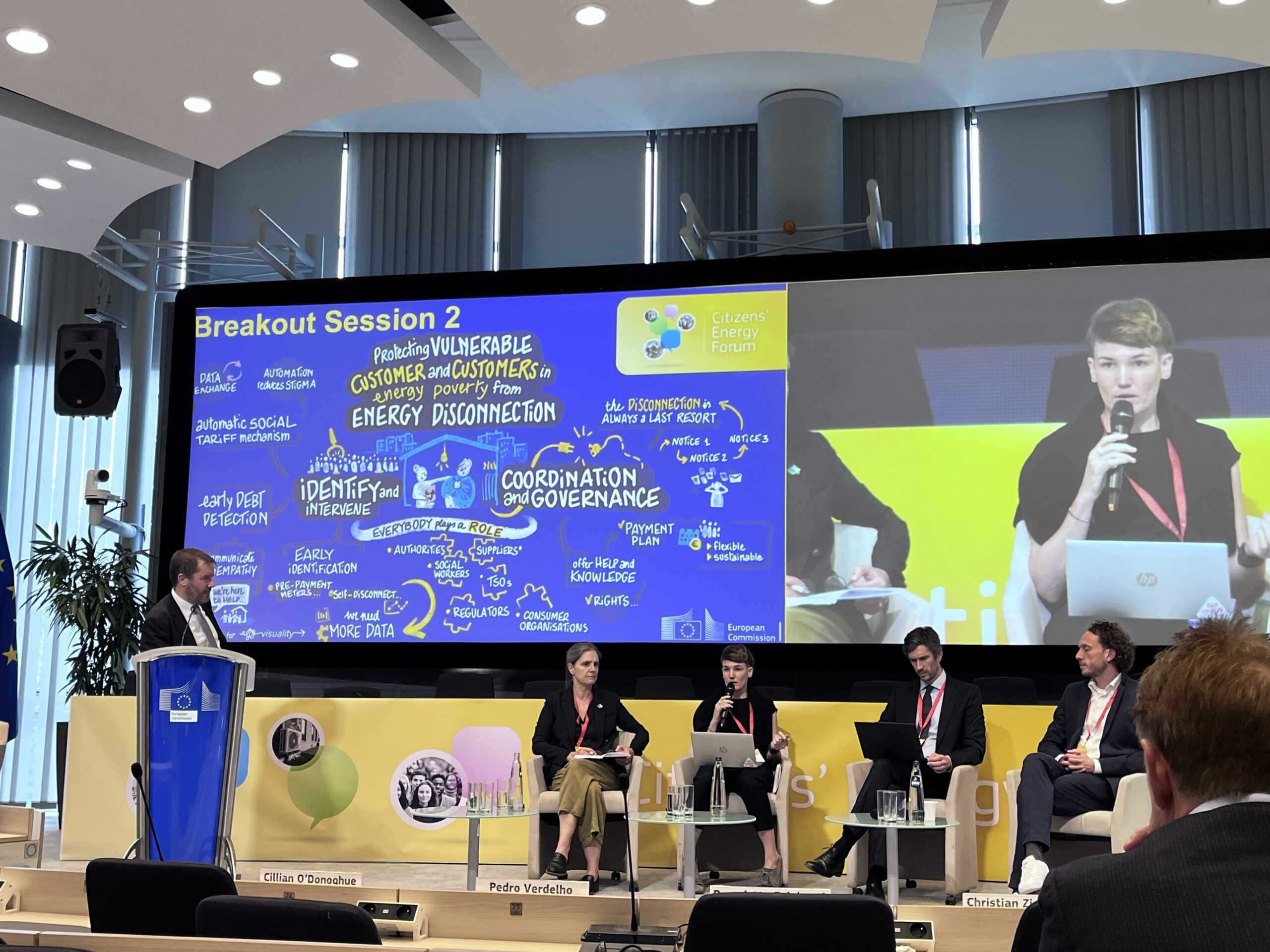
On Thursday, six days after that letter, the Citizens’ Energy Forum meets in Brussels to discuss how the Citizens Energy Package reaches the people it names. Trust is infrastructure. Thursday will show whether the room treats it that way, and whether attention turns into standing.
I will be listening for three signals. The first is tailored solutions: whether implementation recognises the people who, like the hairdresser, fall between the categories of household and enterprise. The second is feedback loops: whether the complaints that reach ombudsmen and advice services travel back to those who write the rules, with an obligation to respond. The third is funding: whether ombudsmen and consumer organisations are resourced as the infrastructure of trust they already are.
The day after the Forum, a closed-door regulatory roundtable brings together EU-level stakeholders, Member States and energy regulators. Standing is precisely what such rooms allocate.
A market can be measured by what happens on the day someone like her cannot pay, and by who is entitled to speak for her before the notice arrives.
P.S. If there is a voice you would like to hear on Energ’Ethic, reply to this edition and tell me who. And if you would like to help the podcast grow, you can support it on Patreon or write to me about sponsoring an episode.
References. CEER Report on Consumer Protection Issues 2026 (21 September 2026). Building Better Markets(Citizens Advice). State of the Union address, 16 September 2026. World Resources Institute, Strengthening the Investment Case for Climate Adaptation (June 2025). Citizens’ Energy Forum 2026.